

Hi! I’m Thiago H. Mota!
I am a historian of Africa with a passion for uncovering the ways peoples, ideas, and cultures have traveled and transformed across continents. I am an Assistant Professor of African History at the University of California, Santa Cruz. My research and teaching explore the interconnected histories of Africa, Europe, and the Americas, with particular focus on Islamic expansion, colonial encounters, and the global circulation of knowledge.
I earned my Ph.D. through a joint program between the Federal University of Minas Gerais (Brazil) and the University of Lisbon (Portugal), supported by fieldwork and archival research in West Africa and Europe. My dissertation, which received honorable mention in the Agostinho Neto Prize for Historical Research (Angola/UNESCO), forms the basis of my forthcoming book Global Islam from Africa: Muslim Expansion in West Africa and its Impact upon Europe and the Americas (15th–19th Centuries).

My research has been sponsored by several institutions, such as Fulbright Commission (USA), Marie-Curie Program/Horizon 2020 (EU), CNPq, CAPES, and FAPEMIG (Brazil), Camoes Institute and Portuguese Language Universities Association (Portugal). Through these generous fundings, I have undertaken research in Africa, Europe and the Americas, in archives and Museums located in Senegal, Gambia, Guinea-Bissau, Mozambique, Portugal, France, Germany, Brazil, USA, among others. The outcome is a global approach of African History, with special focus on Islamic expansion in Africa and its reverberation across the Atlantic world.
Before joining the University of California, Santa Cruz as Assistant Professor of African History, I taught for six years at the Federal University of Viçosa (Brazil). There, I helped design inclusive curricula, co-authored two books on anti-racist education and African/Islamic history, and hosted Viva la Música, a public-facing podcast on music and history. I also led the History Undergraduate Studies Program, which earned national recognition under my coordination.

My teaching style centers on active learning strategies, drawing on my extensive experience with African archives, fieldwork, and immersive engagement across multiple countries on the continent. In my courses, students work directly with primary sources from African archives, analyzing manuscripts, documents, and other historical materials firsthand. This hands-on approach allows them to develop critical thinking skills, experience the process of historical inquiry, and connect classroom learning to the real-world contexts of African history.
Beyond the classroom, I have coordinated cross-cultural academic partnerships in Mozambique, China, and Guinea-Bissau, always seeking to connect people and institutions across borders. Back in Brazil, my work has been acknowledge along with my students. In 2022, I coordinated a project that won the the national prize at 19th CNPq Award for Outstanding Scientific and Technological Initiation, Human and Social Sciences, Letters and Arts – Technological Initiation Category, CNPq. The project undertook research about African-Brazilian arts and implemented QR codes at the Museu do Oratório (Ouro Preto, MG) to enhance visitors experience with African aesthetics in Colonial and Imperial Brazil.
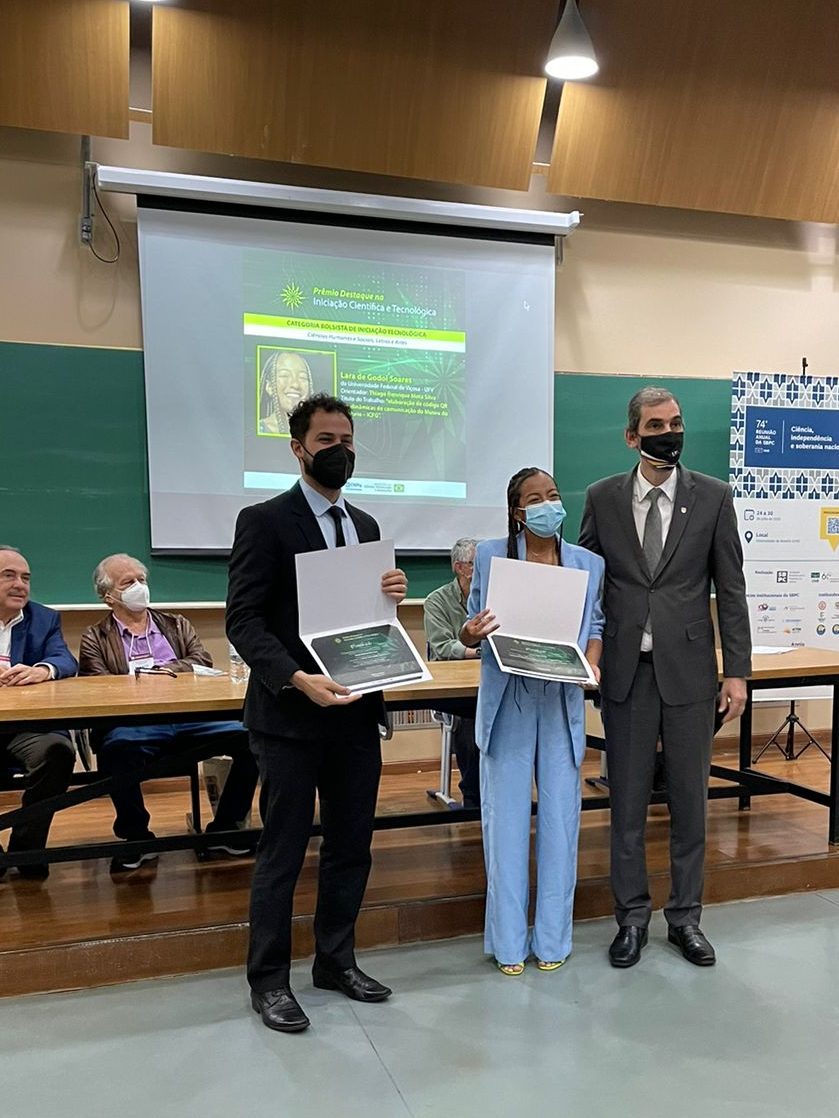
19th CNPq Award for Outstanding Scientific and Technological Initiation, Human and Social Sciences, Letters and Arts – with my mentee Lara de Godoi Soares (middle) and the chancellor of the Federal University of Viçosa, prof. Demetrius David da Silva (right), Brasília, 2022.
These experiences have strengthened my conviction that history is not just about the past: it is about creating meaningful dialogues in the present and imagining more connected futures. My broader goal, both in research and teaching, is to expand the visibility of Africa’s histories and highlight their central role in the making of our world.
 Thiago H. Mota